Kaity Starting Member 2 Posts
I have quite a few questions about the HPW Recipe. First off I have been feeding the BML and I have heard it is better.It's easier, more natural and makes your glider smell better and just better for your gliders. Can anybody go into detail abou how and why it's good for my gliders and better than the BML Recipe.
Second, I was wondering where I can buy the supplies. I only need too find the HPW powder and the bee pollen however every site I have found is either outdate and does not sell anymore or is out of stalk or everything.
shop.firstcoastsuggiesstore.com/category.sc?categoryId=3
is one of the sites I was told about but they are sold out... anyway thank you very much guys.
LuckyGlider Zippy Glidershorts     TX, USA 5266 Posts TX, USA 5266 Posts Dear Kaity, you ask some really good questions. Before I offer answers just wanted to give you a little background... I am a director at the 501(c)3 public charity animal rescue called Lucky Glider Rescue & Sanctuary in Nevada. We serve the western U.S. We also operate under the auspices of USDA with a class B license owing to the fact that we collect a flat-rate adoption fee of $125 per glider (technically makes us "brokers" in the eyes of the USDA). This covers the cost of neutering and health care. We host free sugar glider animal husbandry courses and nutritional workshops. This is in addition to standard rescue, rehabilitation, and adoption services. We have conducted years of research on these diets. We have also developed an LGRS diet regimine that has been reviewed and approved by a sugar glider nutritional expert. In addition to the animals who have been rehabilitated and re-homed there are 90+ gliders here on that regimine who recieve regular oversight with our USDA vet care professional. She (Christine Kolmstetter) is also the family and pet vet in addition to our rescue vet. We chose her carefully out of a list of professionals that was first expert on sugar gliders and second, expert on nutrition. We think after years of service, we made a wise decision. In addition to her DVM, Dr. Kolmstetter has a bachelor's degree in chemistry and a master's degree in biochemistry and nutrition. Based on her experiences with LGRS, she sends people here for advice on glider diets. During a workshop she was the guest speaker at here, she cites glider nutrition as the biggest health issue with the hundreds upon hundreds of gliders she's cared for. Here is what we at LGRS have researched and found (just the highlights to answer Kaity's questions and the questions so many others have asked about on the very same topic): BML BML is an OK diet. Our analysis did uncover; however, that the wheat germ is packed with iron. Vets we have conferred with have generally agreed that little glider livers have a hard time processing iron. We recommend that you speak to your vet about this to see what he or she has to say. Other than that, you could keep feeding BML if they are eating it with proper fruits and veggies on the side. HPW Diet The HPW diet is an OK diet too, but based on our nutritional analysis, the soup alone is weak on the Calcium side. So if you are going to feed it, you need to bump up the calcium. We do that by substituting Papaya and Orange Juice for the water. You can also add a plop of yogurt to bump the calcium. (more mods below). HPW Diet vs. BML What makes BML vs. HPW a "better" diet may end up being what fruits and veggies you feed on the side. In other words, HPW is not necessarily "better" than BML. We are generally not impressed with the lack of guidance on these diets with regards the suitable rotation of proper fruits and vegetables on the side. Both kind of fail in that regard and make a big assumption that you know what you're doing. It is *NOT* recommended that you just plop down the "trio" of corn/peas/carrots that come conveniently frozen together in a bag. That trio is woefully upside-down Ca:Ph wise and can RUIN the overall effect of these diets. So whether you are feeding BML or HPW may have more to do with the 'compote' not the soup. Just make sure the Ca:ph ratios are close to 2:1 and watch the oxalates which zero-out the calcium in dark green veggies. The gliderpedia here has a wealth of information on the ingredients of fruits and veggies, so let that data be your guide. I just mention this because what F+V you feed on the side has a profound effect on the overall diet. MODS on HPW used at LGRS Back to the mods we have done at LGRS on HPW... In addition to the papaya/orange/yogurt subs, we also discovered that you don't have to use HPW powder. If you send an email to Passwell/Womberoo, the makers, they will send you the nutritional breakdown. When you compare that to other high-quality protein powders, you will find cheaper alternatives. We use Trader Darwin's Vanilla Flavored Soy instead. You can get a whole 2 pound tub of it for $12 compared to a whopping $20 for 250g of HPW. The other mod is to take out one egg and replace it with two tablespoons of dehydrated fly pupae ( www.oregonfeederinsects.com/).
This is a high protein but low fat, low cholesteral food. [DISCLAIMER: we have no commercial affiliation with Oregon Feeder Insects. Nor do we sell bee pollen (just go to bulkfoods.com) or HPW. Our diet regimine was not developed to sell its ingredients for commercial gain. We are a non-profit outfit. Our motivation is purely to help gliders.] RESULTS The results we are seeing with the Calcium fortified morph of HPW we use at LGRS are outstanding. Over 90 gliders are on this diet here at the rescue. The ones that come in with HLP and Metabolic Bone Disease respond well to this diet. Over the past several years, skinny little waifs with splotchy brown spots have blossumed into healthy, good-looking animals. Based on periodic vet health checks and visits, we are feeding properly. Sorry for repeat for you veterans out there. Top photos are before and after with HPW diet, others are before and after with LGRS diet: 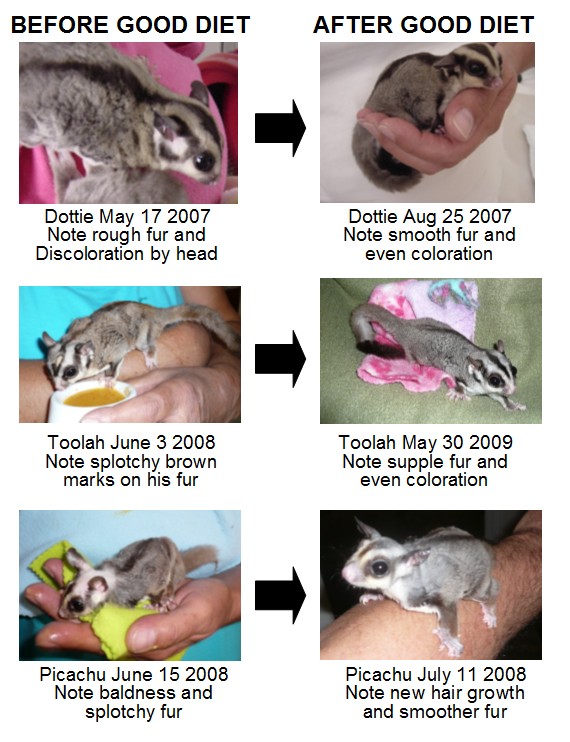
Just for fun.... Here is a photo of a dietary workshop in process at LGRS kithcen. We hold monthly meetups and do suggie school and dietary workshops by appointment. If you are in the Las Vegas area on vacation or passing through and you want to visit the rescue, you can make an appointment to experience the free workshops. Call: 877-504-5145 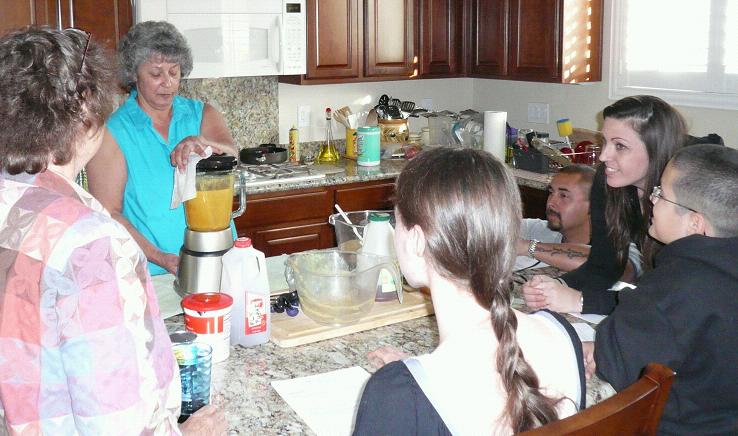
Candy Cuddle Bear FL, USA 8110 Posts I have to agree with LuckyGlider on the differences in HPW and BML and the difficulty in getting a 2:1 overall ratio with either of them. I have compared several nutritional elements of these diets and personally feel BML contains too much additional calcium (from supplements formulated for reptiles). It is however designed for folks that want to feed the standard "mixed vegetable" combination that has a backward ratio. Then on the other hand HPW itself is on the low side and almost impossible to get to a 2:1 ratio with the fruits and vegetables most of us use daily. These diets are also very different BML (high) and HPW (low on protein, fat and sugar content when you break them down to a per glider serving amount. For these reasons, I also have a hybrid diet that I have been using for several months. I have called it the Blended Diet. It contains the same foods as BML except the Wheat Germ and the reptile vitamins and calcium. I use HPW as the source for most vitamins and a small amount of human grade calcium. The values for this diet fall mid-range between HPW and BML (see my chart below) Hopefully the columns come out readable. The ratio for this diet is high enough that a wide variety of fruits and vegetables can be used (I offer something different each night) and the overall ratio with the F&V remains close to the 2:1 goal. Blended Diet INGREDIENTS: 1/2 cup Honey 1/2 cup Warm Water 1 bottle (4 oz) Mixed Fruit Juice with Yogurt (Gerber) 3 TBS High Protein Wombaroo Powder 1/4 cup (4 TBS) Mixed Cereal (Gerber or Beechnut) 3/4 tsp Now Brand Calcium Carbonate (health food store purchase) 1 TBS Bee Pollen 1 jar(2.5 oz) Strained Chicken or Turkey(Beechnut or Gerber) 1/4 cup (2 oz) Yogurt -Plain (or low fat Vanilla - no artificial sweeteners) I put all ingredients and blend at high speed to break up the bee pollen. It stores well frozen and the recipe makes about 60 portions - it feeds my 9 gliders for a week. I feed 2 tsp per glider plus 1 TBS Fruit & 1 TBS Vegetable. Comparison Chart: HPW Diet / BLENDED DIET / BML Diet Calcium 4.75 / 28.47 / 59.40 Phosphorus 5.23 / 11.12 / 18.79 Ratio 0.9:1 / 2.6:1 / 3.2:1 Protein 0.32 / 0.66 / 1.00 Sugar 2.84 / 2.83 / 3.50 Fat 0.13 / 0.20 / 0.50 Fiber 0.06 / 0.11 / 0.16 Ed - I would love to know what proportions you use on the Papaya and Orange Juice combination and how you prepare it to substitute for the water in your HPW morph diet. I'll be posting more on the Blended Diet on my web page in the next few days, www.GliderKids.com for anyone that is interested Candy LuckyGlider Zippy Glidershorts TX, USA 5266 Posts Further to my comment on weakness in the calcium department and how I am not impressed with the F&V advice from some diet purveyors, I thought this additional post would be useful for people who are interested in diet details. Specifically, based on what the www.sweet-sugar-gliders.com says.... I recommend doing your own analysis to come up with your own opinion. I will donate my opionion in the hopes that what I say may cause you to look into it yourself. here goes... www.sweet-sugar-gliders.com cites two fruit and veggie "relish" formulas which I think are a move in the right direction in helping people to rotate fruits and veggies for the HPW diet. When I say "move in the right direction" I think it's good for them to try to give people guidance on the F&V front. But... based on the already weak 1.29:1 Ca:Ph ratio of the standalone soup, these "relishes" do not even get 2:1 on their own let alone bump up the soup's weakness in the Ca area. To be more exact: Relish #1 The site says it's a 1.2:1 Ca:Ph ratio based on the following ingredients: 1 cup cucumber 1 cup fresh or frozen peas 1 cup sweet potato 4 cups bok choy With the HPW soup itself 1.29:1 Ca:Ph, adding an equally "shy" 1.2:1 relish on the side does not make up for that. Simply put two "weak" Ca:Ph ratios don't make a good ratio. 2:1 is what we need to strive for, not 1.2:1 or 1.29:1 Maybe this is why some people have complained that HPW has caused HLP? I still maintain that the HPW diet is a good starting point, but it just needs a little tweaking and tender loving attention from people who use it. Relish #2 1.75:1 1 cup frozen vegetable mix of peas, green beans, carrots, & corn 1 cup jicama 1 cup sweet potato 4 cups turnip greens Unsweetened apple juice (if needed) Same basic comment here, 1.75:1 for this relsih and the 1.29:1 for the soup just aint' 2:1. Worse, this 1.75:1 Ca:Ph ratio does not seem to take into account he relatively high Oxalate content of the turnip greens. Sady, foods high in Oxalates block calcium absorbtion to the tune of 90% to 100% according to the many sources I have looked into. For every 100 grams of Raw Turnip Greens, there are 190 mg of Calcium and 42 mg of Phosphorus. On the surface, this looks deceivingly good ratio-wise yielding a 4.52:1 Ca:Ph ratio. But it's misleading because of the high Oxalate content that cancels most all of the calcium: According to the USDA, for every 100 grams of Turnip greens, there are 50 mg of Oxalates. www.ars.usda.gov/Services/docs.htm?docid=9444
So what's the Point? The point is: 1. be curious, analyze, ask and look to improve. 2. be stingy with your devotion to a diet. Any suggie lover who cares about diet and wants to tweak these diets can do so equipped with the very good tools right here on sugarglider.com in the gliderpedia. Dare to believe in yourself. It's OK to be an amatuer and a layperson and do what I am suggeting so long as you confer the results with your vet or nutritional expert. Happy diet tweaking to you all. LuckyGlider Zippy Glidershorts TX, USA 5266 Posts Candy, about your question "Ed - I would love to know what proportions you use on the Papaya and Orange Juice combination and how you prepare it to substitute for the water in your HPW morph diet." Well based on your post you already know the favorable ratios of those two fruits. The proportions depend on available material. For example, if we have fresh papaya, we know the ratio is 4.8:1 so blending it in the blender with some orange juice to water it down is going to give you an average of 4.8:1 and 2.8:1 of the orange assuming you use the same amounts. Now there are a few ways, given the materials on hand, this could change a little. For example, if you buy calcium-fortified juice, the ratios of the two fruits will be closer together. With a plop of yogurt, the water substitue here gets you in the 2:1 range on the soup. In terms of preparation, that's a matter of personal style. I like to warm the honey in glass containers using a water bath or microwave. And then I pour it in the blender with the juices and yogurt already blending. We blend the bee pollen and dehydrated fly pupae separately to get fine powder and then blend that in with the eggs into the first liquid. This is done in stages because we make gallons at a time to feed close to 100 gliders a day... LuckyGlider Zippy Glidershorts TX, USA 5266 Posts I run the risk of someone saying "duh we knew that" but I am going to say it anyway..... For those of you who are a little intimidated on doing the calculations that under the "resources" tab here you will see the word "nutrition." If you go to the nutrition page there, you will see choices such as "create recipe." Guys, this is just an AWESOME tool the administrators of this site have labored to provide us! With this free and totally awesome tool at your fingertips, you don't have to worry about not being an "expert" or just a layperson at diets. It takes only a little effort and you can figure out a good fruit and veggie rotation compote or whole diets. I recommend creating separate recipes for each fruit and veggie "compote" (relish?) you want to try. It lets you create and name various recipes. It lets you add ingredients by browsing the nutrition database and it gives you all the popular varieties of foods. It lets you pick the amount and then it automatically calculates EVERYTHING using a color chart and it even pops out all the amounts of all the nutrients, etc. There is also a little conversion calculator. Like I said AWESOME. So use it and don't be afraid of goofing around with the ratios. Yuu can play little "what if" scenarios by tweaking the amount of whatever ingredient you put in. And it all automatically re-calculates. The only "gotcha" is to be aware of the Oxalate thing with dark leafy veggies. For the most part oxalates cancel out the calcium in that particular food. And of course it lets you SAVE AND EDIT your creations so you don't lose anything. Awesome. You can even keep your creations private until you are done perfecting them and then publicize them when you are ready to share. all I can say is "wow" LuckyGlider Zippy Glidershorts TX, USA 5266 Posts Luckily for us all, the 2:1 ratio is one of the simpler ones. All it means is you want twice as much calcium as phosphorus. So when the recipe tool shows you the added-up values of all the ingredients you put in your recipe - just look at the ca and ph values. If there is not twice as much ca as ph - either add more ca-rich ingredients, or take away from the ph-rich ingredients until the graph shows you there is twice as much ca as ph. OK to make this a little easier, I have created a sample "recipe" which is a simple combination of corn and papaya. It is labeled "CornPapayaExample" in the "Public Recipes" section here: www.sugarglider.com/nutrition/publicrecipes.asp
In this example, I played around with the amounts of each item until the totals of calcium and phosphorus showed that there was twice as much Calcium as Phosphorus. It ended up, just by using the "edit" button and adding more papaya to the recipe incrementally, that TEN TIMES as much papaya was necessary to offset the phosphorus-rich corn (1000 grams of Papaya and 100 grams of corn). That combination of 1000 grams of Papaya and 100 grams of corn yields 243 mg of Ca and 125 mg of Phosphorus. So 243:125 is about twice as much calcium as phosphorus. That's about the same as saying 2:1. now.... 1000 grams is about 35 ounces 100 grams is about 3.5 ounces And since the combination of these two would yield roughly 5 whole cups, that might be too large of a batch if you only have a few gliders. So you can just mix ten teaspoons of papaya with one teaspoon of corn. Since there are three teaspoons to a tablespoon, that would be just about the right amount for a two-glider serving. Now here's the problem. What if they just eat the corn and leave the papaya? They would not get the right ratio would they? In this case, you can mash the two together. So what if they don't eat it mashed up? Well then there's always the soup. And since, if you follow my advice, you will bump up the Calcium in the soup to get a 2:1 ratio, at least if they eat just the soup they'll still get the right ratio... So if you use the tool and just add more of one thing and less of the other until the amount of calcium is twice as much as the phosphorus, that's all you have to do. please note that there are different kinds of corn (white, yellow, etc.) and the ratios are different for each one. So buy the one you actually pick in the recipe tool. IowaMisty Joey  17 Posts 17 Posts Ed, I appreciate all of your comments. I got your email recently about the diet you're using and am hoping to find some time soon to look at it more closely. As far as my relishes go, when HPW mixture is used with both one of my fruit smoothie recipes and one of my veggie relish recipes, the ratio is always over 1.5:1. (You didn't take the smoothie into account when you did your math above or use the actual mg of ca & ph to calculate total ratio.) I've heard the recommended ratio is 1.5-2:1, so I try to stay in that range. I have some new smoothie & relish recipes in the works that I will add to my website soon. I'm also changing one of the existing recipes. People always seem so confused about what fruits & veggies to feed with HPW. My goal is just to come up with several recipes that they can use , which will help them get in the right ballpark if they're not wanting to or able to sit down & do the math themselves. Many of these diets are so confusing. I do like your ideas of bumping up the ratio of the main HPW mixture by using papaya juice. Since we have oranges in our fruit smoothie, I'm not sure if I'd put orange juice in the mixture. I know too much citrus can cause diarrhea. I also like the fly pupae idea. I'm excited to look over your diet more closely. I've just been extremely busy lately. I definitely appreciate all of the work you put into researching glider diet. There is so much that is unknown about it. None of us should ever be too stuck on a diet or too proud to switch to something else. If it's better for the gliders, we should be doing it. The hard part is that gliders haven't been in captivity long enough and not enough studies have been done to really know what's working. Even many of the main diets have only been around for 7 yrs or less, which isn't really enough time to get a full picture of the average life span & overall health of gliders on that diet. Back to the original post: I'm not going to bash either BML or HPW. They've both been used by many breeders for several years with great success. I have heard several stories from people about their glider's coats looking better on HPW. We've had great success with HPW with our own gliders and they really do like it. For our lifestyle, HPW is much easier to make (less ingredients) and I do feel it more closely resembles the nutrients they'd be getting in the wild. If you need HPW supplies, I have them at store.sweet-sugar-gliders.com
and I do sell both in the 250g size boxes you see everywhere else, as well as in 1/4-cup sizes that make sense with the actual HPW diet recipe. Thanks, Misty SassyNat Starting Member 2 Posts I posted this in another thread but wanted to post it here as well just in case. I am wondering if feeding mealworms can substitute the fly pupae? My gliders go nuts over their mealies.  I've been feeding them about 7 per day each. If not what else can I use that i could possibly get locally without ordering online? Also is there a link for the best F+V plan to go with the LGRS version of HPW? I am still trying to decide whether to switch from BML to HPW. I feel my head is swimming in so much info and I am not sure where to look for an all-around concise lay it all out for me so I don't screw up diet plan. Whew can you tell im treading water? lol BTW- yes I am a newbie to gliders (about a month) Thank you  What if you try to add rep cal calcium to hpw to go to the 2:1 ratio? good idea or bad?
 |
New Message |
 |
|
. |
|


 Home
Home Glider Gossip
 Gliderpedia
 Journals
 Resources


